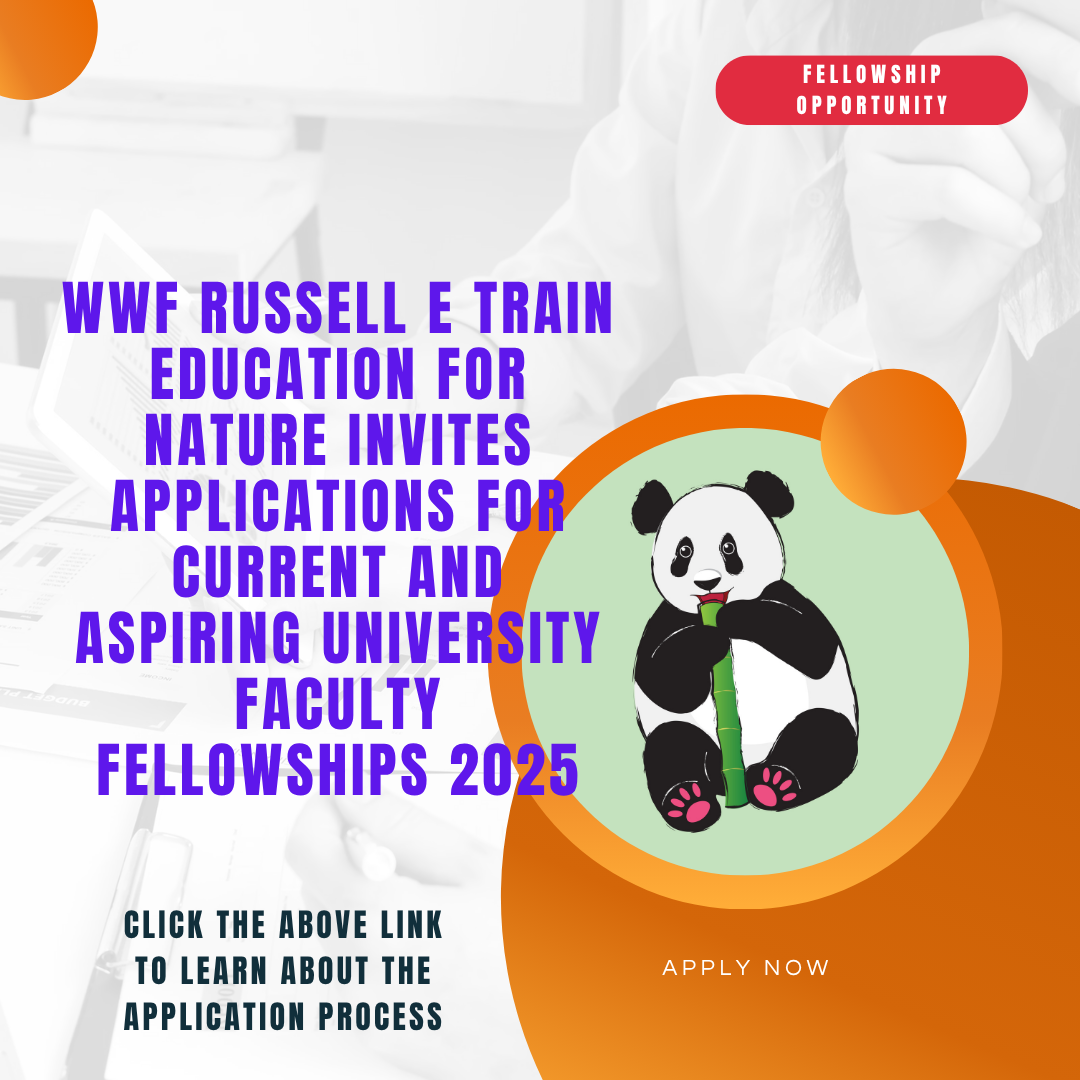
WWF Russell E Train Education for Nature Invites applications for Current and Aspiring University Faculty Fellowships 2025, While progress has been made to address the shortage of adequate expertise in higher education across many countries, locally led and contextually relevant solutions are still needed to recruit, retain, scale, and sustain academic and research expertise at both institutional and national levels.
The WWF Russell E. Train Education for Nature Program (EFN) provides funding support to current and aspiring university faculty affiliated with or employed at universities in Africa, Asia, Latin America, and the Caribbean. This opportunity supports doctoral degree studies in the natural and social sciences, as well as other conservation-related fields. Strong university faculty are essential for the effective exchange of knowledge, expertise, and skills, as well as for fostering leadership. Faculty members inspire and mentor students, design curricula, promote learning and idea sharing, lead and collaborate on research, and disseminate scientific outcomes.
WWF Train Fellows are expected to enhance, expand, or support the development of intergenerational scientific expertise within a university in their home country or region. Through this initiative, WWF aims to strengthen the capacity of local and regional faculty to train current and future conservation leaders—thereby promoting equitable and accessible conservation science, education, and leadership for the benefit of both people and nature. Fellows will also have the opportunity to join the global EFN alumni community, enabling ongoing knowledge exchange and collective impact.
Applicants may request funding for up to three years, with a maximum of $30,000 per year. The amount awarded will vary based on the proposal. Successful applicants will be notified in June 2026.
If you’re interested in this prestigious fellowship program, we encourage you to read the article carefully and follow the application guidelines closely. Make sure to review all eligibility criteria and submit your application within the specified timeline.
Last Date of Application: 18th December 2025
Eligibility Criteria
(WWF Russell E Train Education for Nature Invites applications for Current and Aspiring University Faculty Fellowships 2025)
Applicants must meet all of the following criteria to be eligible:
- You must be a citizen of an eligible country.
- You must have at least two years of conservation-related work, research, or academic experience.
- You must have an existing affiliation with a college or university in an eligible country and demonstrate collaboration and strategic partnership with national and/or regional institutions. Priority will be given to individuals affiliated with underserved universities.
- You must show a strong commitment to working in academia in an eligible country — for example, by mentoring and guiding early-career conservation leaders and scientists.
- You must be enrolled in or admitted to a PhD program, either in your home country or abroad.
- You must plan to begin your studies no later than January 2027.
- You must contact EFN if you are a WWF employee, consultant, or a previous EFN grant recipient to determine your eligibility.
- You must submit all required documents by the application deadline: December 18, 2025, at 11:59 PM (U.S. Eastern Time).
Focus Areas
(WWF Russell E Train Education for Nature Invites applications for Current and Aspiring University Faculty Fellowships 2025)
The fellowship aims to bridge academic excellence and conservation research by providing hands-on experience, learning, and training opportunities. The proposed research topics may encompass a wide range of themes. Finalists will be selected through a competitive evaluation process and assessed based on several criteria, including but not limited to the following areas:
- Academic and professional contributions/potential: The applicant’s commitment to academic, research, and professional growth.
- Strength and quality of the research proposal: The uniqueness, relevance, and clarity of the proposed topic and action plan. The proposal should demonstrate a strong understanding of the fellowship’s objectives and aim to explore solutions at the intersection of climate, conservation, people, and sustainable development. The proposed activities must be feasible within the given timeframe and budget.
- Individual and collective impact: The applicant’s potential to excel in conservation research and leadership, along with the anticipated short-term and long-term impacts of their work. The research should aim to deliver lasting conservation outcomes beyond the academic or research period. Proposals that engage diverse stakeholders—particularly through gender inclusion and participation of local and Indigenous communities—will be prioritized. Applicants should also demonstrate the ability to build partnerships and actively engage with local communities, academic institutions, researchers, and practitioners.
- Project measurability: The proposed research must include clearly defined and measurable outcomes and outputs.
- Collaborations: The applicant should show the potential to strengthen partnerships that extend beyond the project’s specific objectives and timeframe.
- Recommendation letters: The applicant must meet the fellowship’s specific criteria, with recommendation letters providing concrete examples of the applicant’s skills, qualifications, and suitability for the program.
Eligible Countries
(WWF Russell E Train Education for Nature Invites applications for Current and Aspiring University Faculty Fellowships 2025)
- This fellowship is open to applicants from eligible countries within WWF-US priority areas.
Belize, Bhutan, Bolivia, Brazil, Cambodia, Cameroon, Central African Republic, Chile, Colombia, Democratic Republic of Congo, Ecuador, Fiji, French Guiana, Gabon, Guatemala, Guyana, Honduras, Indonesia, Kenya, Laos, Madagascar, Malaysia, Mozambique, Myanmar, Namibia, Nepal, Paraguay, Peru, Republic of Congo, Suriname, Tanzania, Uganda, Vietnam, Zambia
How to apply?
(WWF Russell E Train Education for Nature Invites applications for Current and Aspiring University Faculty Fellowships 2025)
Applicants can access the online applica7on and guidelines at www.worldwildlife.org/efn. Applicants may apply in
English, Spanish, French, or Portuguese. The applica7on deadline is December 18, 2025 by 11:59 PM US Eastern Time.
For More Information
Please e-mail EFN at efn@wwfus.org or visit www.worldlife.org/efn for more information
Learn more about the Fellowship Program
No more Google search, join our Whats App Channel and get alerts as soon as we publish a post.
Hey, STEAL our Best Premium Content For Absolutely Free, Check Out the Links below
HOPE these will add value to your existing skills and knowledge.
Our information bears no cost (it’s absolutely FREE), don’t let valuable information slip away.
Join our community of avid readers who are always in the know. Subscribe to our website; stay connected and engaged with the latest news, trends, and developments by subscribing today.
(PUSH the bell ICON)
Leverage the power of knowledge to propel your organization to new heights. Don’t miss out – explore our content
- Latest Funds for NGOs,
- NGO Jobs
- Resources (Helpful Guides and Courses)
- Premium Resources
- NGO related articles
NGO Grants, NGO Jobs, NGO Resources & Nonprofit Fellowships – Empowering Your Mission (ngoscope.com)
Sharing is appreciated