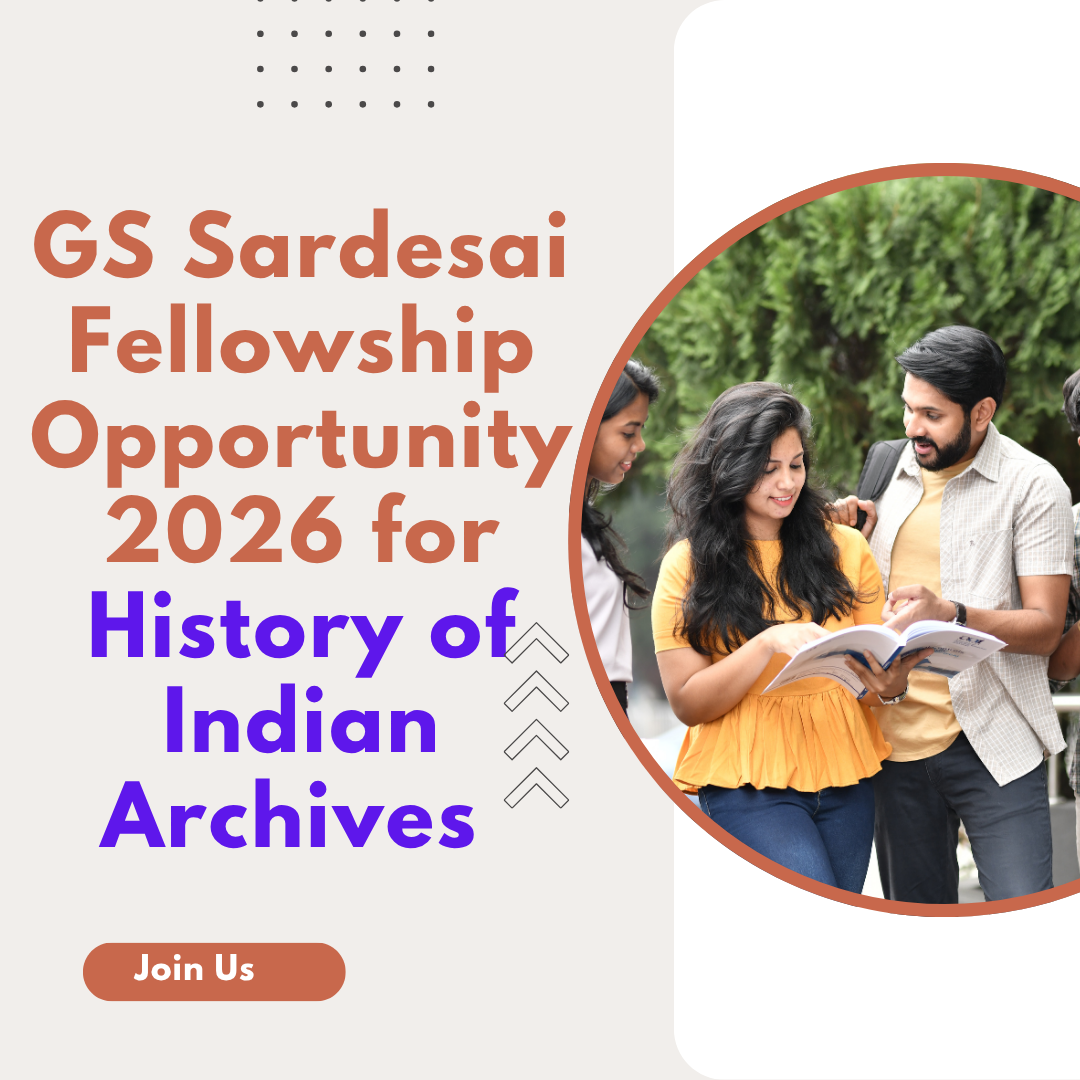
GS Sardesai Fellowship Opportunity 2026 for History of Indian Archives Applications now open, Govind Sakharam Sardesai (1865–1959) is regarded as one of India’s most diligent historians and pioneering archivists. At the request of Jadunath Sarkar, he took on the enormous responsibility of examining the Peshwa daftar—the extensive administrative and personal records of the Maratha Peshwas—carefully organising, editing, and publishing thousands of documents. His contributions played a crucial role in establishing a strong foundation for archival-based historical research in India.
The Foundation for Indian Historical and Cultural Research (FIHCR) continues to celebrate this legacy through the G.S. Sardesai Fellowship. This initiative goes beyond traditional historical writing, focusing instead on strengthening the core of historical research—the preservation, study, and interpretation of primary sources.
If you’re interested in this prestigious fellowship program, we encourage you to read the article carefully and follow the application guidelines closely. Make sure to review all eligibility criteria and submit your application within the specified timeline.
Last Date of Application: 10th May 2026
Objectives for GS Sardesai Fellowship Opportunity 2026 for History of Indian Archives Applications now open
The G.S. Sardesai Fellowship for History of Indian Archives (GSFHIA) is designed to support scholars, researchers, and writers engaged in a fully funded, one-year project focused on archival research.
Unlike typical fellowships, this programme places emphasis on the primary sources themselves, encouraging participants to uncover, study, edit, and publish archival materials that have not been widely explored.
The key aims of the fellowship are to:
- Reinforce and enrich India’s archival infrastructure
- Promote the exploration of lesser-known and underutilised archives
- Facilitate the development of documentary resources for future research
- Encourage thorough, evidence-driven archival scholarship
Fellowship Themes & Scope for GS Sardesai Fellowship Opportunity 2026 for History of Indian Archives Applications now open
This fellowship welcomes projects that focus on:
- The history and evolution of specific archives
- Compilation and editing of document collections
- Translation and annotation of primary source materials
- Cataloguing, preservation, and documentation of archives
- Institutional histories related to record-keeping practices
Scope of Work
Selected fellows will be expected to:
- Identify and document archival materials
- Compile and organise primary sources
- Conduct contextual and historical analysis
- Develop well-structured, research-ready outputs
Eligibility Criteria
The fellowship is open to:
- Independent researchers and scholars
- Archivists and academic researchers
- Writers, historians, and authors
- Academics and PhD candidates (provided the project is independent of their degree work)
Applicants must:
- Be Indian citizens or Persons of Indian Origin (PIO)
- Demonstrate proven capability in archival research
- Submit a practical and achievable one-year project proposal
- Commit to producing a manuscript of book-length quality by the end of the fellowship
How to apply?
Applicants are required to submit the following:
- Research Proposal (PDF | 5–7 pages)
Title: Clear and descriptive title of your project
Abstract: A concise summary (500 words) of your research question, its significance and contemporary relevance.
Background & Literature Review: Context for your project, including existing scholarship and research gaps that your work addresses, and how it makes a significant and original contribution to the literature.
A Brief note on the USP: A concise statement (in 250 words) explaining what makes the book proposal unique, interesting, and different from competitors, justifying why it deserves to be published and read.
Research Questions: The specific historical questions your project seeks to answer
Methodology: Your approach to research (archival work, oral history, quantitative analysis, etc.)
Sources & Archives: Primary and secondary sources you will consult; archives or collections you plan to visit.
Chapter Outline: Tentative structure of your manuscript (5–8 chapters)
Timeline: A realistic work plan structured over a fixed period of 12 months, covering research, writing, and revision phases.
Note: Your proposal must be sharply focused and demonstrate that the project can be completed within one year and is publish worthy.
- Curriculum Vitae (CV)
- Writing Sample (3,000–5,000 words)
- Budget Plan
- Co-applicant details (if applicable)
- Contact details of at least two professional or academic references.
This fellowship is open to Indian nationals, including Indian Citizens and Persons of Indian Origin (PIO).
Shortlisted candidates will be contacted by end of July 2026.
For queries, please write to satyajeet.ojha@fihcr.com or namisha.bothra@fihcr.com
Learn more about the Fellowship Program
No more Google search, join our Whats App Channel and get alerts as soon as we publish a post.
Hey, STEAL our Best Premium Content For Absolutely Free, Check Out the Links below
HOPE these will add value to your existing skills and knowledge.
Our information bears no cost (it’s absolutely FREE), don’t let valuable information slip away.
Join our community of avid readers who are always in the know. Subscribe to our website; stay connected and engaged with the latest news, trends, and developments by subscribing today.
(PUSH the bell ICON)
Leverage the power of knowledge to propel your organization to new heights. Don’t miss out – explore our content
- Latest Funds for NGOs,
- NGO Jobs
- Resources (Helpful Guides and Courses)
- Premium Resources
- NGO related articles
NGO Grants, NGO Jobs, NGO Resources & Nonprofit Fellowships – Empowering Your Mission (ngoscope.com)
Sharing is appreciated