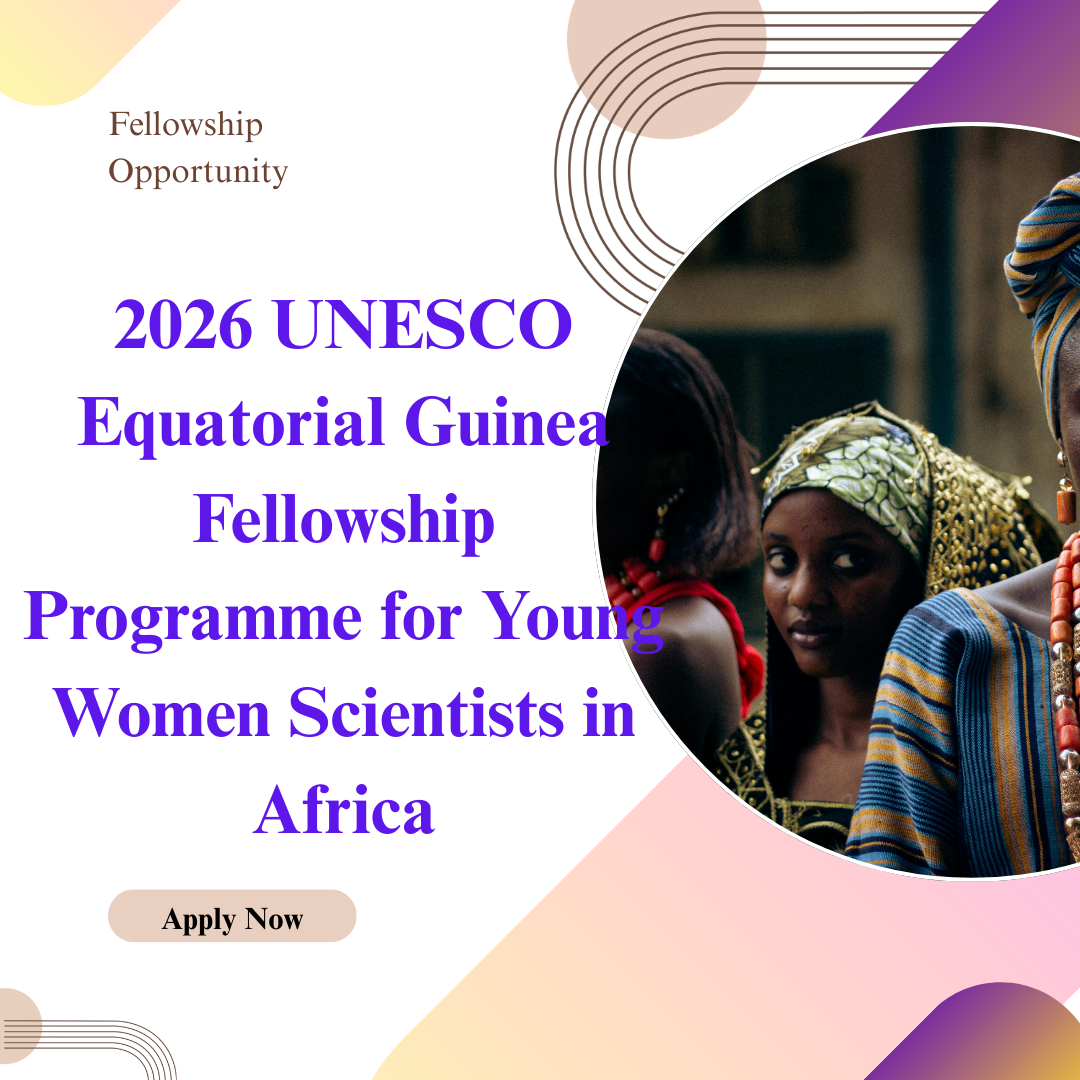
Applications Invited for 2026 UNESCO Equatorial Guinea Fellowship Programme for Young Women Scientists in Africa, The UNESCO-Equatorial Guinea Fellowship supports young African women scientists in the life sciences with a $25,000 grant to advance research and promote equal opportunities in scientific careers. Funded by the Republic of Equatorial Guinea, the fellowship aims to bridge gender and regional disparities in African research and strengthen participation in national scientific development.
Interested candidates are encouraged to carefully review the fellowship opportunity and submit their applications before the specified deadline.
Last Date of Application: 31st March 2026
About the Applications Invited for 2026 UNESCO Equatorial Guinea Fellowship Programme for Young Women Scientists in Africa
Globally, women account for only 33% of researchers, according to the UNESCO Science Report 2021. In Sub-Saharan Africa, the situation is similar, with women representing just 32% of researchers, as reported by the UNESCO Institute for Statistics. These disparities are further influenced by limited investment in scientific research across the region. For instance, Africa accounted for only 1.01% of global spending on scientific research in 2015 and 3.5% of global spending on scientific publications in 2018. Such gaps continue to restrict equal opportunities for women and girls to pursue and thrive in scientific careers.
To address these challenges, UNESCO, in collaboration with the Republic of Equatorial Guinea, has launched a fellowship programme dedicated specifically to young African women scientists. The initiative aims to reduce both gender and regional disparities in research across the African continent. It seeks to promote equal opportunities in science by providing concrete support and encouraging young women to actively contribute to various fields within the life sciences.
The Young African Women Scientists Programme, established in 2024 by UNESCO’s Executive Board and funded by the Republic of Equatorial Guinea, is designed to recognise and support outstanding young African women working in life sciences. The programme encourages their participation in scientific research and technological development within their respective countries. Each year, two young women scientists will receive a $25,000 grant each, totalling $50,000, to support their research projects and help build promising scientific careers.
Eligibility Criteria for Applications Invited for 2026 UNESCO Equatorial Guinea Fellowship Programme for Young Women Scientists in Africa
Applicants must meet the following requirements:
- Must be an African national conducting research at a recognised laboratory in Africa.
- Must be under 45 years of age at the time of application.
- Must hold a PhD in the field of life sciences.
- Must be actively engaged in scientific research related to life sciences, aimed at advancing knowledge and contributing to sustainable development.
Note: Applications cannot be submitted directly by individuals. Only Governments of African Member States, in coordination with their National Commissions, are authorised to submit applications.
How to apply?
Application Submission Process
Applications must be submitted online in either English or French using the designated application form.
Applicants are required to include the following documents and information:
- Research Proposal: A proposal presenting an innovative research idea that can be completed within one year, taking into account the facilities and resources available to the applicant.
- Work Plan: A detailed plan describing the project activities, objectives, expected outcomes, and a timeline showing how the research will be completed within one year.
- Budget Plan: A clear and detailed budget breakdown for the $25,000 grant, explaining how the funds will be used for project implementation (such as materials, equipment, travel, publication fees, etc.). The grant will be disbursed as follows:
- $23,000 will be released at the beginning of the project.
- $2,000 will be released after submission of the final report, which must include the project outcomes and a summary of how the funds were utilised.
- Research Summary: A summary of previous research work, including publications and other supporting materials, with key publications clearly highlighted.
- Curriculum Vitae (CV): A comprehensive CV outlining academic qualifications, professional positions, research experience, and current work.
- Recommendation Letters: Two recommendation letters from a thesis supervisor or a peer working in the same research field (who is not part of the candidate’s immediate environment).
Note: Self-nominations will not be accepted, and incomplete applications will not be considered.
UNESCO-Equatorial Guinea International Prize – Account Requests
Learn more about the Fellowship Program
No more Google search, join our Whats App Channel and get alerts as soon as we publish a post.
Hey, STEAL our Best Premium Content For Absolutely Free, Check Out the Links below
HOPE these will add value to your existing skills and knowledge.
Our information bears no cost (it’s absolutely FREE), don’t let valuable information slip away.
Join our community of avid readers who are always in the know. Subscribe to our website; stay connected and engaged with the latest news, trends, and developments by subscribing today.
(PUSH the bell ICON)
Leverage the power of knowledge to propel your organization to new heights. Don’t miss out – explore our content
- Latest Funds for NGOs,
- NGO Jobs
- Resources (Helpful Guides and Courses)
- Premium Resources
- NGO related articles
NGO Grants, NGO Jobs, NGO Resources & Nonprofit Fellowships – Empowering Your Mission (ngoscope.com)
Sharing is appreciated